HartRAO Home > DSS51 History
The facility was actually operated by the South African Council for Scientific and Industrial Research (CSIR) on behalf of NASA, until its closure in 1974. It became a radio astronomy observatory, operating under first the CSIR, then the Foundation for Research Development (FRD), which became the National Research Foundation (NRF) in 1999.
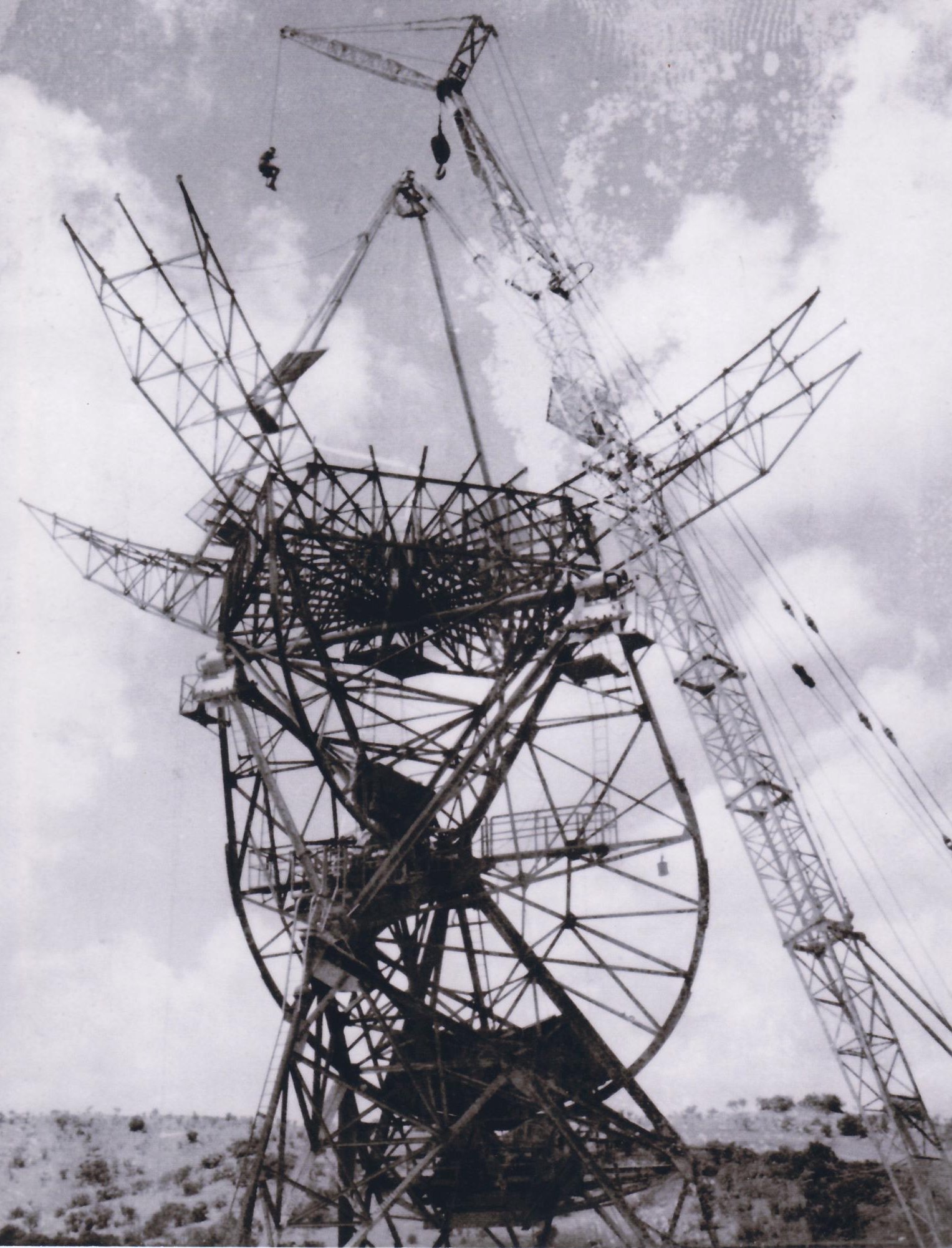
Construction of the Johannesburg station began in January 1961 and it became operational in July 1961, supporting Ranger 1 pre-launch tests (NASA SP-4012 V2 p 573). A photographer named Roelie van Wyk was employed to record progress, and he was caught in action above. In August 2008 Roelie visited the station and presented us with the photo shown, taken 48 years previously. He is the person hanging from the crane.
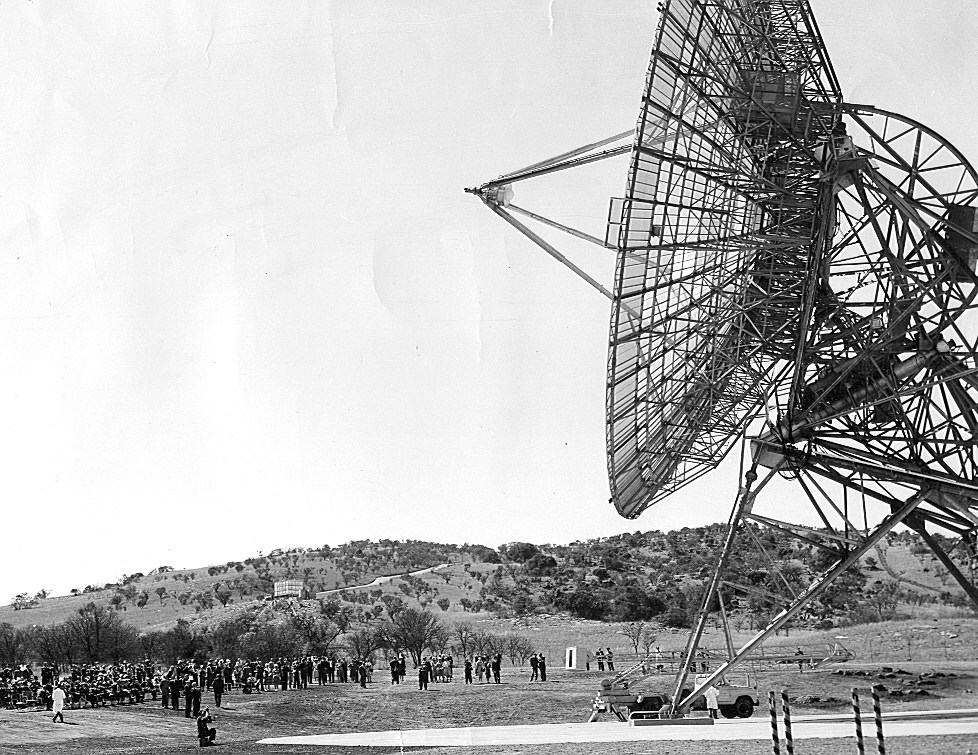
The official opening of the station in 1961 is shown above. The antenna was originally built with an aluminium mesh surface, and operated at a frequency of 960 MHz, i.e. a wavelength of about 30 cm. The lightweight mesh surface was quite transparent optically.
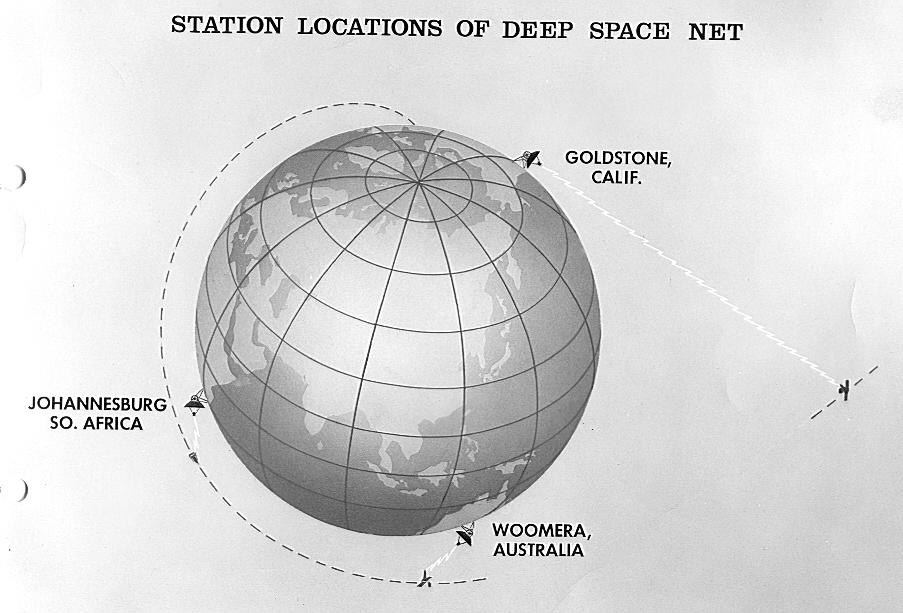
The original stations in the Deep Space Network are shown above - the three original 85' antennas were DSIF 11 at Goldstone, California, United States (retired 1981 to become a museum exhibit), DSIF 41 at Island Lagoon, Woomera, Australia (decomissioned and demolished in 1972) and DSIF 51 at Hartebeesthoek, near Johannesburg, South Africa (decommissioned and transformed into a radio telescope operated by the South African CSIR in 1974).
Construction - More pictures of the construction of the antenna are shown here.
Upgrades - The antenna went through a variety of upgrades
during its working life as a NASA tracking station.
Spacecraft Missions -
DSS 51 was involved in many spacecraft missions
from 1961 to 1974.
Control Room -
See inside the control room at DSS 51.
Sister Antennas - More information about the many sister antennas is found here.
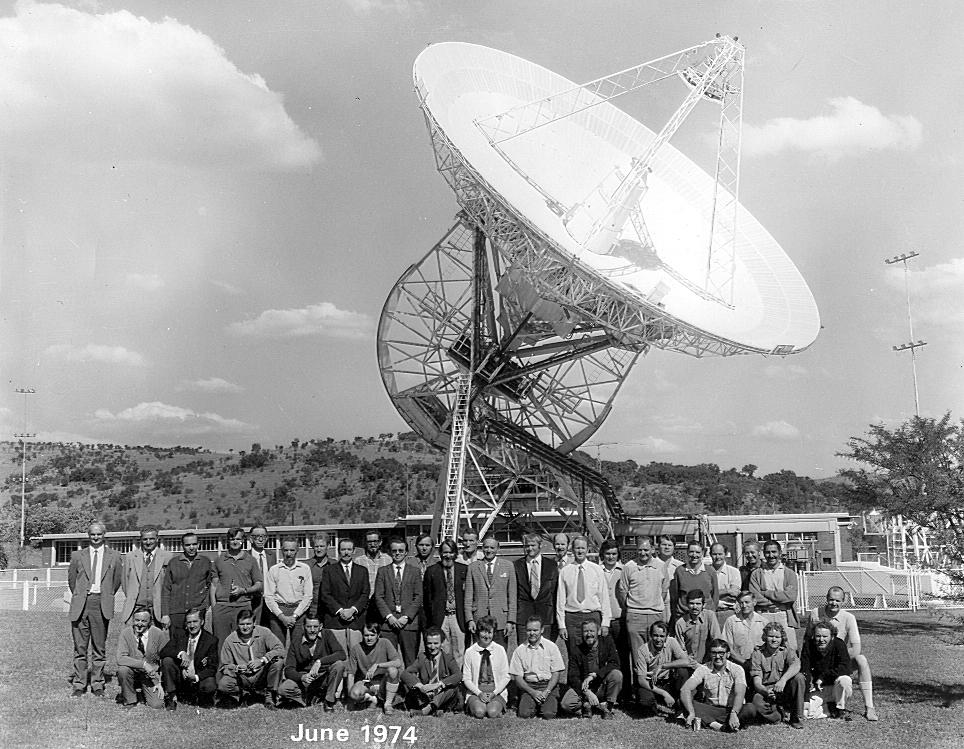
The engineering and technical staff just before the closing of DSS 51 in
June 1974. George Nicolson, the future Director of DSS 51 transformed into
its next incarnation as the Hartebeesthoek Radio Astronomy Observatory,
appears in a black blazer immediately below the north ladder of the
telescope.
Beryl and Roy Coetzee have provided this list of names of the staff in the
photograph:
Back row, left to right -
Front row, left to right :
For more information see:
DSS 51 - The End
Click on the image for large version
John Dinham, Obie Oberholzer, G.I. Fourie, Keith Jones, Mr Miller, Willem de
Lange, Kobie van Zyl, Les Field, Joe Pheiffer, Mike Ainley, Gunther Krantz,
George Nicolson, Bill Grieves, Harry Bryant, Peet Carstens, Jeff Glennister,
Andre de Wet, Louis Alberts, Tommy Llewellyn, Hennie Roesch, Garth
Alexander, Howard Jarman, Jannie Duvenage, Peter Jardine.
Jimmy Archbold, Gibby Gray, Hennie Pieterse, Hennie Naude, ? (store's
assistant), Tony Eyre, Gina Jacobs, Colin Kroesen, Martin van Rijswijk,
Paul Jordaan, Paul Michelow, Nick van Rensburg, Pete Longmore, with
Pieter Bosch, Terry Button and an unidentified student in front.
Information on the Deep Space Network
For more information, see:
NASA's other tracking station at Hartebeesthoek - Minitrack / STADAN /
STADN
The function of DSS51 was primarily tracking spacecraft going beyond Earth
orbit. But NASA also needed to track unmanned spacecraft in Earth orbit. A
Minitrack station was established at Esselen Park between Johannesburg and Pretoria in
1958, but owing to increasing man-made radio interference it was moved in
1960 to a site at Hartebeesthoek, on the hill above what was to become
DSS51. This expanded to become a
Space Tracking and Data Acquisition Network (STADAN) station and it
became operational in this form in June 1961, with station code BUR. It was
also operated by the Council for Scientific and Industrial Research (CSIR)
of South Africa for NASA. Its largest antenna was 40' (12m) in diameter.
STADAN was incorporated with the Manned Space Flight Network (MSFN) in May
1971 to form the Spaceflight Tracking and Data Network (STDN). The
station at Hartebeesthoek was also decommissioned by NASA in the 1970's,
after completion of the near-Earth phase of the Viking Mars mission. It
then became the Satellite Application Centre of the CSIR. On 1 April 2011
this facility became the Space Operations Directorate of the newly formed
South African National Space Agency (SANSA, phone +27 12
334 5000). The two stations (HartRAO and SANSA) are adjacent at
Hartebeesthoek with a common entrance from the R400 Broederstroom road and are often
confused.